Clearer guidance around warehouse racking
Warehouse teams need clear routes between storage areas, picking stations and loading bays. At busy crossings, they also need to know where to stop and what to expect ahead.
Rack Group now offers projected safety signs through our sister company, Beaverswood®. These systems add visual guidance alongside our racking protection, pedestrian barriers and gates.
Together, they support a more comprehensive approach to warehouse safety. Physical protection defines the space, while signs help people understand how to move through it.

The challenge: keeping floor signs clear
Warehouse floors face constant use. Forklifts, pallet trucks and daily footfall can wear painted markings and adhesive signs. As a result, these may need refreshing or replacing.
Around racking aisles, doorways and crossings, the instructions still need to be clear. Staff and drivers must understand which route to follow and where to take care.
Projected safety signs offer another way to display these messages. They use light, so there is no painted or adhesive symbol for traffic to scuff or peel away.
How projected safety signs work
An LED projector casts a selected symbol onto a floor or wall. A small template inside the unit, called a gobo, forms the image.
Options include pedestrian symbols, forklift warnings, directional arrows and speed limit signs. Bespoke designs are also available to suit the application.

Why choose projected safety signs?
Projected signs can reinforce warehouse instructions while reducing the upkeep of floor markings. Key benefits include:
- Less floor-sign maintenance: There is no painted or adhesive symbol to renew at that position.
- Clear visual messages: Bright symbols highlight walkways, vehicle routes and hazards on floors or walls.
- Supports safer movement: Signs reinforce the routes and access points defined by barriers and gates.
- Flexible placement: Projectors can be repositioned when layouts change, subject to a suitable mounting position and setup.
- Potential cost savings: Less repainting and retaping can reduce replacement work and associated downtime.
Example: reinforcing a pedestrian crossing
Consider a picking walkway that meets a forklift route near a racking aisle. Staff need a defined crossing point. Drivers also need a clear warning as they approach.
This is where barriers, gates and projected signs can work together. Each has a different role in the layout.
1. Barriers define the route
Pedestrian barriers can separate the walkway from nearby vehicle movements and guide staff towards the crossing.
The selected system should suit the vehicles, available space and impact risks at that location. Its position must also allow for access to the racking.
2. Gates define the access point
A pedestrian safety gate provides a deliberate access point through the barrier. It also creates a place for staff to pause before entering the crossing.
However, the crossing still needs clear sightlines and suitable site procedures. People on foot and drivers must be able to see each other.
3. Projected signs reinforce the message
A projected warning could highlight the crossing on the vehicle approach. Meanwhile, a symbol beside the gate could reinforce the instruction for people on foot.
In this example, the barriers define the walkway and the gate provides access. The signs help communicate the crossing rules at the point of use.
This reflects HSE guidance to separate pedestrians and vehicles where possible and clearly mark crossing points.


Supporting protection across the facility
The same approach can support movement around storage areas, picking zones and loading bays.
For example, directional arrows could reinforce a one-way route beside racking. Forklift warnings could highlight activity at aisle ends. Near access openings, projected messages could support gates and barrier runs.
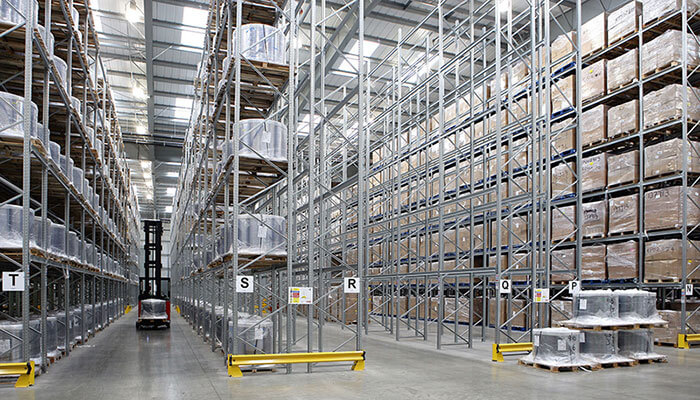
Racking protection and signs serve different purposes. Rack end barriers and upright protectors help protect the storage system from impact. Projected signs provide instructions for people moving around it.
These are potential applications, with the final layout shaped by the site’s risks. Physical protection, traffic management and staff training remain essential.


Planning the right setup
Start with the instruction people need and where they need to see it. Then consider the projection surface, surrounding light, mounting position and possible obstructions.
Around racking, check whether stored goods or moving loads could block the projection. Assess the sign from the approach used by drivers and pedestrians.
Its position should make sense alongside existing barriers, gates and markings. Review the setup when storage layouts or traffic routes change.
Where exit messages are used, check them against the site’s fire safety plan. Keep the required emergency signage and lighting in place.

Add projected signs to your warehouse safety plan
Whether you are reviewing one crossing or planning a wider warehouse upgrade, Rack Group can help you explore the options.
Projected safety signs complement our racking protection, barriers and gates. They add clear visual instructions to a layout built around your people, equipment and storage needs.
Discuss projected safety signs